BDI Concrete Academy
Concrete construction vocabulary
The goal isn't to become an engineer — but so you can speak with engineers in their language. Complete with international equivalents (ACI, Eurocode, JIS, KS, GB).
Concrete Cover
Concrete CoverThe distance between the concrete surface and the outer surface of the rebar. Its function is to protect the rebar from corrosion & fire, maintain strength, and extend the building's lifespan.
Equivalent: Concrete Cover (US/EU/JP/KR) · 混凝土保护层 (CN). BDI keeps the concrete cover exactly as designed.
Rebar
Reinforcing BarSteel bars inside concrete to resist tensile forces — because concrete is strong in compression but weak in tension.
International: Reinforcing Bar / Rebar.
Slab
Floor SlabA flat concrete element: house floors, building floors, concrete roof decks.
Typically uses Multi or Single.
Beam
BeamCarries loads from the slab, then transfers them to the columns.
Column
ColumnA vertical element. Carries loads from the beams, then transfers them to the foundation.
Pile Cap
Pile CapConnects several piles into one unit.
Shear Wall
Shear WallA structural wall that resists earthquakes.
Typically uses Wired Concrete Decking.
Durability
Structural DurabilityHow long the building stays in good condition. The engineer's target is not just strong, but also durable.
Crack
CrackThere are many types of cracks. A crack ≠ building collapse, but it must be analyzed.
Shrinkage
Concrete ShrinkageConcrete shrinks as it dries — normal, but excessive shrinkage can cause cracking.
Honeycomb
HoneycombOccurs when concrete isn't fully compacted, usually due to insufficient vibration, segregation, or leaking formwork.
Corrosion
Rebar CorrosionThe engineer's biggest enemy. When concrete cover is too thin: water gets in, rebar rusts, the building deteriorates.
This is the direct connection to BDI.
Compressive Strength
Concrete Compressive StrengthWritten as fc' or K — for example K250, K300, K500. The higher it is, the stronger against compression.
Ready Mix
Ready-Mix ConcreteConcrete delivered by truck mixer.
K500
Compressive Strength ClassIn Indonesia, K500 means a compressive strength of about 500 kg/cm² — equivalent to ±41 MPa (megapascal).
Concrete Decking
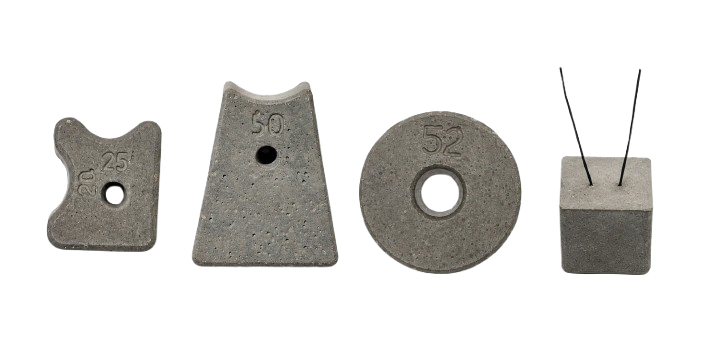
Concrete DeckingAlso called Concrete Spacer or Concrete Cover Block. Its function is to maintain concrete cover.
Interlock
InterlockingA feature of the Multi product. The interlock keeps the rebar position more stable.
Cover Thickness
Concrete Cover ThicknessFor example 20 mm, 25 mm, 40 mm — per the working drawings.
SNI 2847
Structural Concrete RequirementsThe Indonesian standard for structural concrete — equivalent to ACI 318 (America) and Eurocode 2 / EN 1992-1-1 (Europe). Cover tolerances: ACI 117 · Japan: JIS/AIJ · Korea: KDS · China: GB 50010.
💡 Bonus — the right language in the right forum
In engineering forums, use the technical terms Concrete Cover Block, Concrete Spacer, or Concrete Decking. The product is locally known in Indonesia as tahu beton — that name is perfectly good for communicating with workers, foremen, and the local market, but when talking to civil engineering lecturers, structural consultants, or large contractors, use the technical terms.